Welcome back to the Research Blog, your trusted source for laboratory reference materials. Today, we'll take a look at one of the most promising peptides in regenerative medicine research: BPC-157 (Body Protection Compound-157)
What is BPC-157?
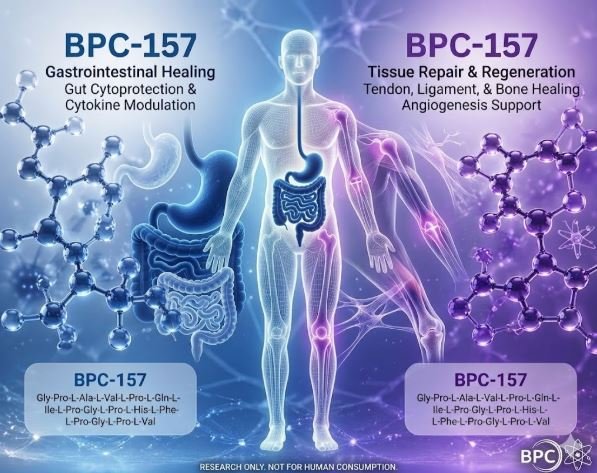
BPC-157 is a synthetically derived peptide composed of 15 amino acids, making it technically a pentadecapeptide. It is based on a protective protein sequence originally identified in human gastric juice, although the version used in modern research is laboratory-synthesized to ensure maximum purity and stability.
Researchers are showing great interest in BPC-157 due to its potential tissue stabilizing and regenerative properties, particularly in the gastrointestinal tract and musculoskeletal system.
Key research areas:
Studies have shown that BPC-157 can positively impact several critical regenerative pathways in laboratory models:
- Connective tissue repair: Data indicates that BPC-157 helps accelerate the regeneration of tendons, ligaments, and even bone tissue.
- Intestinal stabilization: It has a significant cytoprotective (cell-protective) effect, preventing damage resulting from inflammation in the digestive system.
- Inflammation modulation: In vitro models show that it can play a stabilizing role in inflammatory processes without the systemic suppressive effects characteristic of traditional drugs.
- Angiogenesis: Promising research is examining the role of BPC-157 in stimulating angiogenesis (the formation of new blood vessels), which is crucial for effective tissue repair.
Technical data and laboratory service:
To ensure the reproducibility of experiments, stringent cleanliness and storage standards must be followed:
- Summary formula: $C_{62}H_{98}N_{16}O_{22}$
- Cleanliness standard: Minimum purity $\geq$ 98% (HPLC)
- Storage (powder): The lyophilized powder should be stored at room temperature. -20°C for long-term stability.
- Storage (solution): After reconstitution (dissolution), the material should be stored at a temperature of 2°C to 8°C and use within a specific time window to prevent degradation.
Summary
BPC-157 remains a fundamental tool for researchers analyzing the molecular mechanisms of tissue repair and cell protection. Its versatile effects make it a high-priority compound for laboratories focused on regenerative processes and inflammation modulation.
What uses of BPC-157 are currently being researched in your laboratory?
⚠️ FOR RESEARCH PURPOSES ONLY: MANDATORY DISCLAIMER
This compound is intended for laboratory and in vitro research purposes ONLY. Not suitable for human consumption, clinical use, or diagnostic purposes. Institutional handling protocols should be strictly followed.