Welcome back to the peptofit.pl research blog. In the rapidly evolving landscape of scientific research, few compounds generate as much interest and possess such broad interdisciplinary potential as PT-141 (bremelanotide). Although it often receives attention in the mainstream media for its effects on behavior, scientists see it as a powerful and unique tool for studying complex neuroendocrine pathways—particularly those regulating arousal and stress response.
This article provides a simple, fundamental introduction to PT-141, ideal for researchers wishing to expand their knowledge of this particular class of peptides.
What is PT-141?
PT-141, also known by its scientific name Bremelanotide, is a synthetic peptide analog of alpha-melanocyte-stimulating hormone ($\alpha$-MSH). It belongs to the class melanocortin receptor agonists.
Scientists initially observed its behavior-modulating properties while studying related melanocortin analogues for their effects on skin pigmentation and the cardiovascular system. Unlike traditional methods, which focus solely on blood flow, PT-141 opened up an entirely new avenue of research thanks to its unique mechanism of action.
Understanding the Unique Mechanism: Central vs. Peripheral Action
The primary scientific significance of PT-141 lies in its site of action. Traditional compounds studied for sexual dysfunction often act through the vascular system (peripherally), increasing blood flow via nitric oxide (NO) or phosphodiesterase (PDE) inhibition.
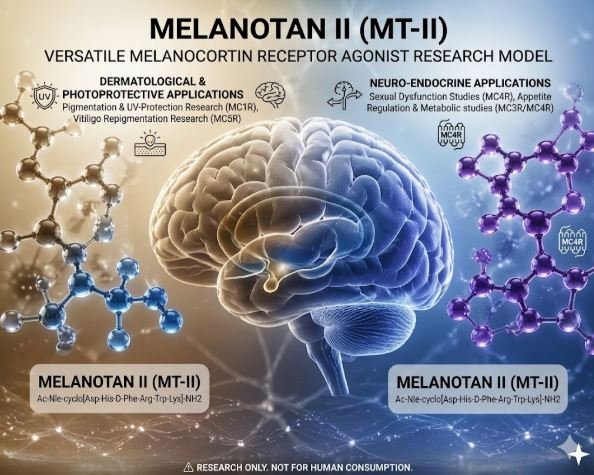
PT-141 works differently – it acts centrally. It has the ability to cross the blood-brain barrier and bind directly to melanocortin receptors (specifically MC3R and MC4R) in the central nervous system, particularly the hypothalamus. By activating these receptors, researchers are investigating how this peptide triggers a cascade of behavioral pathways related to arousal and desire, bypassing vascular restrictions.
Key Research Applications of PT-141
Scientists actively use PT-141 in a variety of scientific models, including:
- Hypoactive Sexual Desire Disorder (HSDD): Preclinical studies are focusing on the potential of PT-141 to increase baseline levels of sexual motivation, specifically measuring its effects on dopamine release and receptor activity.
- Erectile dysfunction (ED): Although not its primary target, PT-141 is being evaluated in ED models where vascular-focused treatments have proven ineffective, precisely because of its distinct central mechanism.
- Behavioral neuroscience: As an MC4R agonist, PT-141 is being investigated in broader work addressing behavioral motivation, satiety signals, and anxiety-related behaviors in animal models.
Storage and Handling: Best Practices
To maintain the integrity and stability of the lyophilized peptide, the following procedures are recommended in laboratory environments:
- Storage (after reconstitution): After reconstitution with sterile water, PT-141 should be stored in a refrigerator (2°C to 8°C). Avoid freezing the prepared solution. Reconstituted vials should be used within the specified testing timeframe.
- Storage (lyophilisate): Unopened vials may be stored in a freezer (-20°C) for long-term stability.
- Pollution control: Reconstitution must always be performed under sterile conditions using appropriate laboratory techniques.
PT-141 at peptofit.pl
At peptofit.pl, we understand that reproducible, high-quality data starts with high-quality reference materials. Our PT-141 peptide is sourced with the highest purity and stability to meet the demanding standards of professional laboratory environments.
IMPORTANT: PT-141 and all materials provided by peptofit.pl are intended for laboratory and in vitro research purposes only. They are NOT intended for human consumption or diagnostic use. Strict handling guidelines apply.